Some fractions may look different, but are really the same, for example: It is usually best to show an answer using the simplest fraction ( 1/2 in this case ). That is called Simplifying, or Reducing the Fraction. We call the top number the Numerator, it is the number of parts we have.
This process can be used for any number of fractions. Just multiply the numerators and denominators of each fraction in the problem by the product of the denominators of all the other fractions (not including its own respective denominator) in the problem.
What is a Fraction? Fractions represent the parts of a whole or collection of objects. A fraction has two parts. The number on the top of the line is called the numerator. It tells how many equal parts of the whole or collection are taken. The number below the line is called the denominator.
Fractions are numerical expressions used to represent parts of a whole or ratios between quantities. Example: If an apple is divided into 4 equal parts, and one part is taken out, thus the fraction representing the taken out part is 1/4 as one part is taken out of 4 equal parts.
A fraction can be defined as a part of a whole. Explore more about fractions, parts, types, representation with concepts, definition, examples & solutions.
This page includes Fractions worksheets for understanding fractions including modeling, comparing, ordering, simplifying and converting fractions and operations with fractions.
Know the importance of Fractions. Refer to types of fractions and their usage for various numbers. Follow the definition of fraction numbers along with properties, real-life examples. Check important points to convert fractions into decimals
Test your understanding of Fractions with these 30 questions. In this topic, we will explore fractions conceptually and add, subtract, multiply, and divide fractions.
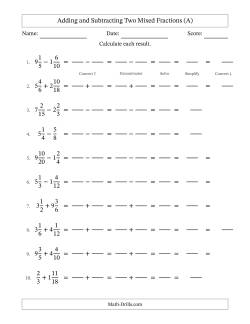 This page includes Fractions worksheets for understanding fractions including modeling, comparing, ordering, simplifying and converting fractions and operations with fractions.